
Introduction
sched_ext is transforming Linux kernel scheduler development with its extensible, BPF-powered approach. Since its inception as an RFC, it has grown into a diverse ecosystem spanning custom schedulers, user-space tooling, and production-ready components. This article provides a deep dive into the major scheduler classes, their unique design goals, and the management utilities powering the system.
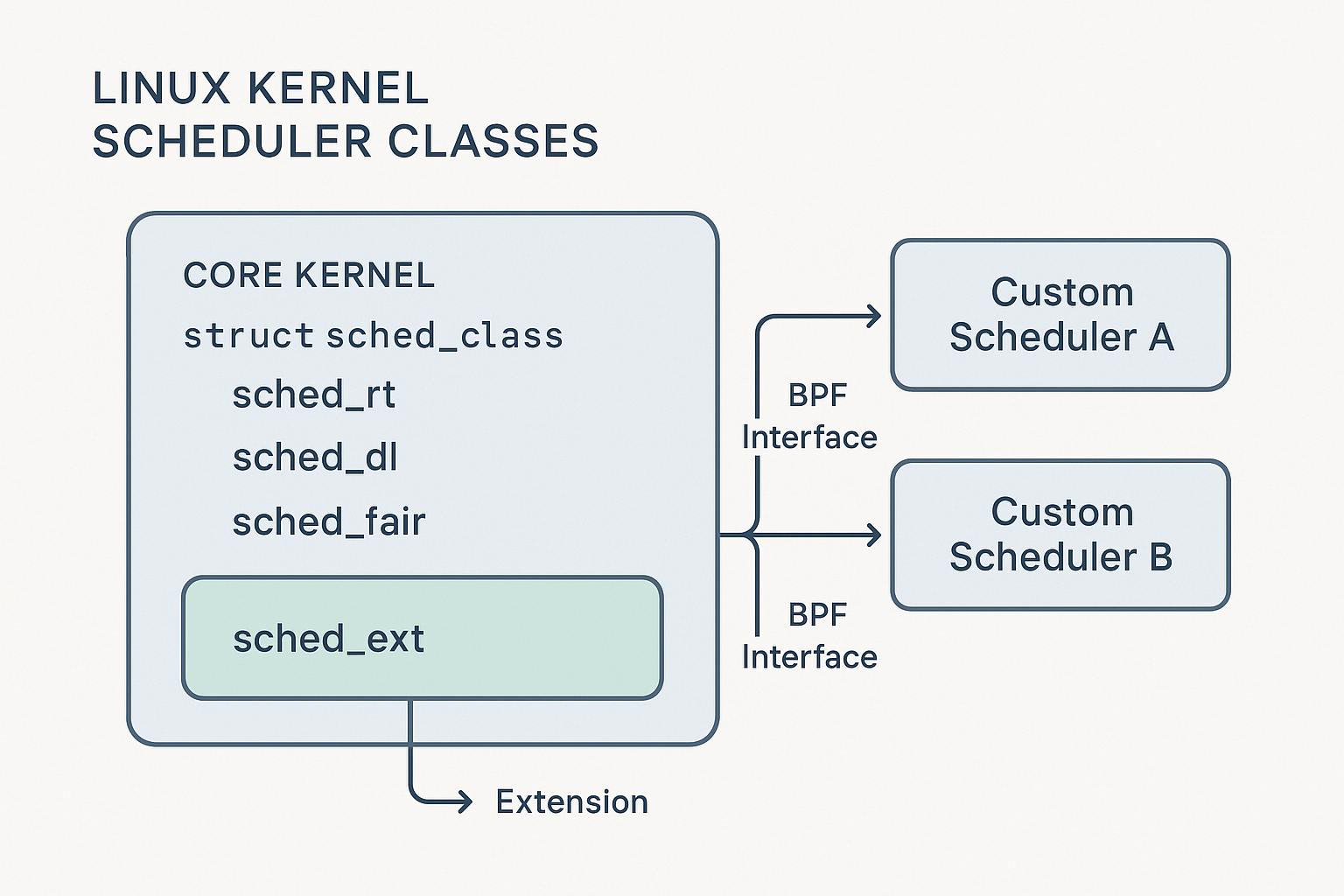
Here’s how sched_ext integrates with the kernel’s sched_class model, enabling pluggable, BPF-based scheduler modules:
Categories of sched_ext Schedulers
The ecosystem features a rich variety of schedulers. They are grouped below by core use case and derived architectural principles:
Demonstrative and Foundational
- scx_simple
Minimal “hello world” scheduler. Implements FIFO and vtime; ideal for understanding the core extension points and eBPF API.
Use case: Education, demonstration. - scx_central
Makes all scheduling decisions on a single CPU, amortizing timer overhead on large systems.
Use case: Virtualization, experimentation on topology effects.
General-Purpose
- scx_rusty
Combines BPF event hooks and Rust code with round-robin logic inside L3 cache domains and user-space load balancing.
Use case: Production systems seeking switchable, tunable scheduling. - scx_p2dq
“Pick-two” load balancer—picks the least busy among two random CPUs, optimizing across locality and response time.
Use case: Systems needing balanced throughput and fairness.
Gaming & Low-Latency
- scx_lavd
Latency-Aware Virtual Deadline scheduler, built to sustain low frame time outliers for gaming and multimedia (e.g., 1% low FPS in Steam Deck scenarios).
Use case: Gaming, multimedia playback, graphics workloads.
- scx_bpfland
Blends vruntime accounting with interactivity boosts and NUMA/topology awareness.
Use case: Desktop, responsive UI environments. - scx_cosmos
Deadline-based scheduling for soft real-time applications—audio/video or XR workloads.
Use case: Soft RT, media servers.
Hybrid & Experimental
- scx_rustland
Moves significant logic into user space (Rust), with only a thin BPF shim in kernel.
Use case: Prototyping, rapid iteration.
- scx_tickless
Suppresses periodic scheduler ticks on select CPUs to minimize jitter, valuable for HPC or cloud latency determinism.
Use case: HPC, cloud workloads, benchmarking. - scx_flatcg
Flattens cgroup hierarchy, accelerating CPU controller response time in deeply nested workloads.
Use case: Complex containerized/multitenant environments.
Management Tools
To coordinate and automate the usage of schedulers, the following tools are central:
- scx_loader
- A persistent management daemon exposing a D-Bus API.
- Handles scheduling module lifecycles, configuration transitions, and integration with desktop/system managers.
- scxctl
- Command-line tool for enumerating, loading, or switching schedulers.
- Supports scripting and workflow automation.
- Predefined Modes
- Turnkey preset profiles—e.g., Gaming, Server, Power Saving—targeting different priority mixes and efficiency settings.
Summary
The sched_ext ecosystem represents a leap forward in kernel scheduling: it offers depth through its novel BPF-driven extensibility, breadth through its range of schedulers, and usability via standard tooling. Whether in research, gaming, or datacenter production, workload-specific scheduling has never been more practical or accessible.